Ginger has been studied in many randomized human trials, especially for nausea and selected digestive, inflammatory and metabolic outcomes. That broad evidence does not establish oral ginger as a sleep treatment.

Origin
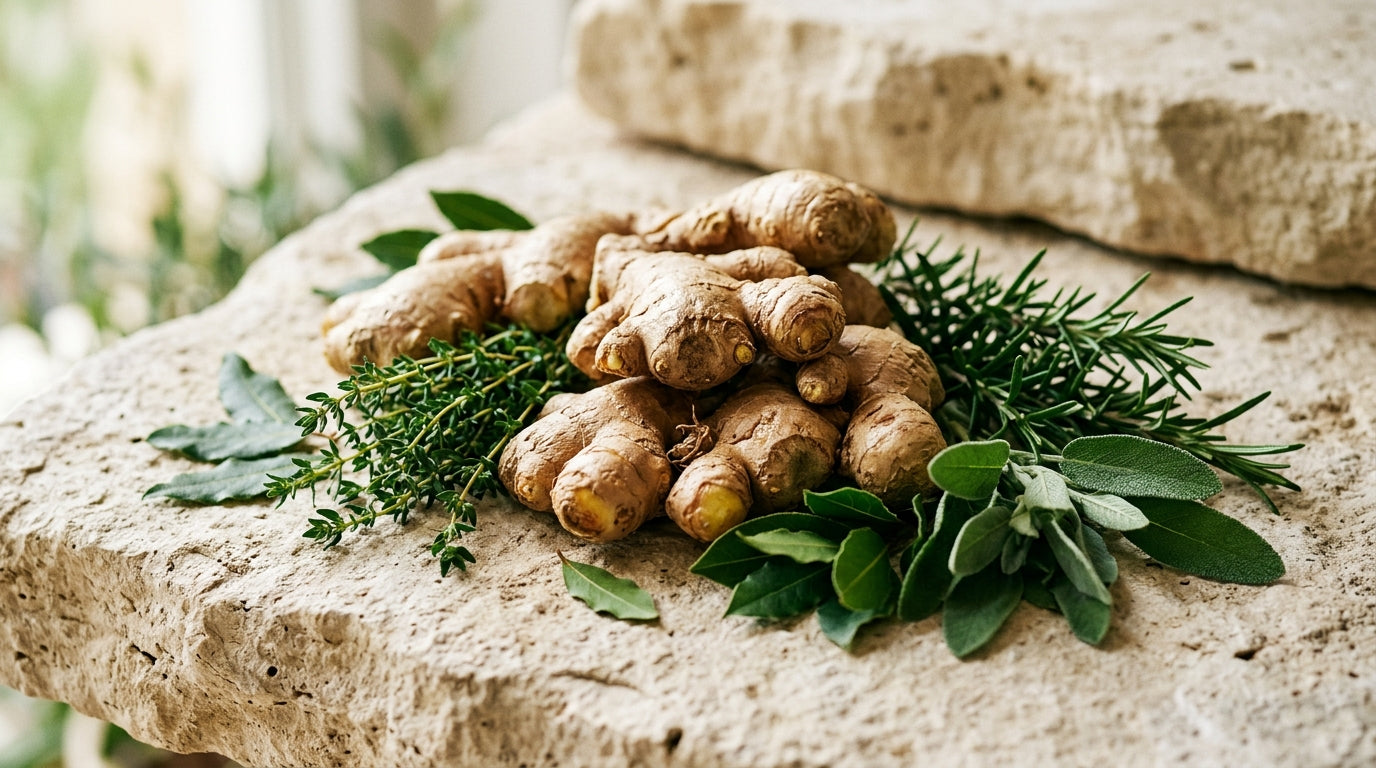
Zingiber officinale, commonly known as Ginger, is a warming, aromatic rhizome native to the tropical and subtropical regions of Southeast Asia, particularly India, China, and Indonesia. Cultivated for thousands of years, it is a foundational pillar in Ayurvedic, Traditional Chinese, and Unani medicine. Ginger is revered in functional nutrition for its potent digestive, anti-inflammatory, and circulatory benefits, driven by its powerful bioactive compounds.
Potential benefits
The strongest human evidence concerns selected nausea and digestive outcomes; findings for other outcomes vary by preparation and population. Oral sleep efficacy is not established.
How it works
Ginger's 6-gingerol and 6-shogaol compounds suppress nuclear factor kappa B (NF-κB) activation, reducing pro-inflammatory cytokines IL-1β, TNF-α, and IL-6. These bioactives simultaneously inhibit cyclooxygenase-2 (COX-2) and lipoxygenase (LOX) enzymes, decreasing prostaglandin and leukotriene production. Additionally, gingerols activate the Nrf2 signaling pathway, upregulating antioxidant defense genes including glutamate-cysteine ligase catalytic subunit (GCLC) and heme oxygenase-1 (HO-1).
What the research says
Ginger has a meaningful human literature, but evidence must be matched to the exact route, preparation and outcome. This page does not convert non-oral or ingredient research into a finished-product sleep claim.
Safety and interactions
Safety data specific to ginger leaf consumption is limited, as most safety studies focus on ginger rhizome preparations. Generally, ginger may interact with anticoagulant medications due to potential effects on platelet aggregation and bleeding time. Individuals with gallstone disease should exercise caution as ginger may stimulate bile production. Pregnant women should consult healthcare providers before using ginger leaf preparations, despite ginger rhizome's established safety profile for pregnancy-related nausea.
Suggested use
Ginger preparations, routes and doses differed widely across trials. Use the protocol from the study matching the intended outcome; footbath research is not an oral-dose source. Check medication and bleeding-risk considerations with a clinician.
Frequently asked questions
What is the difference between ginger leaf and ginger root?
Ginger leaf contains similar gingerol compounds as the rhizome but in different concentrations, with 6-gingerol being the primary bioactive. The leaf typically has a milder flavor profile and different volatile oil composition compared to the more concentrated rhizome preparations.
How much ginger leaf is safe to consume daily?
Specific dosage recommendations for ginger leaf are not well-established in clinical literature. Animal studies used doses ranging from 0.1-100 mg/kg, but human equivalent doses require clinical validation and should be determined with healthcare provider guidance.
Can ginger leaf help with digestive issues?
Ginger leaf contains 6-gingerol which stimulates gastric motility and enzyme secretion, potentially relieving bloating and indigestion. However, most digestive health studies focus on ginger rhizome preparations rather than leaf-specific formulations.
Does ginger leaf have anti-cancer properties?
Laboratory studies show that ginger compounds like 10-gingerol can induce cancer cell apoptosis and cause cell cycle arrest in G0/G1 phase. However, these effects are demonstrated primarily in cell culture studies, and human clinical trials are needed to confirm anti-cancer efficacy.
Is ginger leaf effective for inflammation?
Ginger leaf's 6-gingerol and zingerone compounds demonstrate anti-inflammatory activity by suppressing NF-κB activation and inhibiting COX-2 enzymes in laboratory studies. Animal research shows reduced inflammatory cytokines IL-1β and TNF-α, though human clinical validation is limited.
Is ginger leaf safe to use during pregnancy and breastfeeding?
Ginger leaf is generally recognized as safe during pregnancy for nausea relief, with multiple clinical studies supporting its use for morning sickness at doses up to 1-2 grams daily. However, pregnant women should consult their healthcare provider before supplementing, as individual risk factors may warrant caution. Limited safety data exists for breastfeeding, so professional guidance is recommended during lactation.
Does ginger leaf interact with blood thinners or anticoagulant medications?
Ginger leaf may have mild anticoagulant properties and could theoretically potentiate the effects of blood thinners like warfarin or aspirin, though clinical interactions are rare at typical supplemental doses. Individuals taking prescription anticoagulants should inform their healthcare provider before using ginger leaf supplements to avoid any increased bleeding risk. Timing separation between ginger supplementation and medication doses may be recommended by a physician.
What is the most bioavailable form of ginger leaf—fresh, dried, powder, or extract?
Standardized ginger leaf extracts typically offer the highest bioavailability of active compounds like gingerols and shogaols, as extraction concentrates these phytonutrients compared to whole dried leaf or powder. Fresh ginger leaf contains higher moisture content and may be less concentrated, while dried powder provides a middle ground between bioavailability and convenience. Individual absorption varies based on digestive health and whether ginger is consumed with food or fat, which enhances uptake of its fat-soluble compounds.
References
- https://fdc.nal.usda.gov/fdc-app.html#/search?query=Ginger+Leaf
- https://fdc.nal.usda.gov/food-search?query=Ginger+%28Zingiber+officinale%29
- https://www.ncbi.nlm.nih.gov/search/all/?term=Ginger+Leaf
- https://pubmed.ncbi.nlm.nih.gov/32019599
- https://pubmed.ncbi.nlm.nih.gov/?term=Ginger+%28Zingiber+officinale%29
- https://www.ncbi.nlm.nih.gov/pmc/articles/PMC6341159/
- https://www.sciencedirect.com/science/article/pii/S0308814619312371
This article is educational and is not medical advice. Statements have not been evaluated by the FDA and are not intended to diagnose, treat, cure, or prevent any disease. Consult a healthcare professional before use.