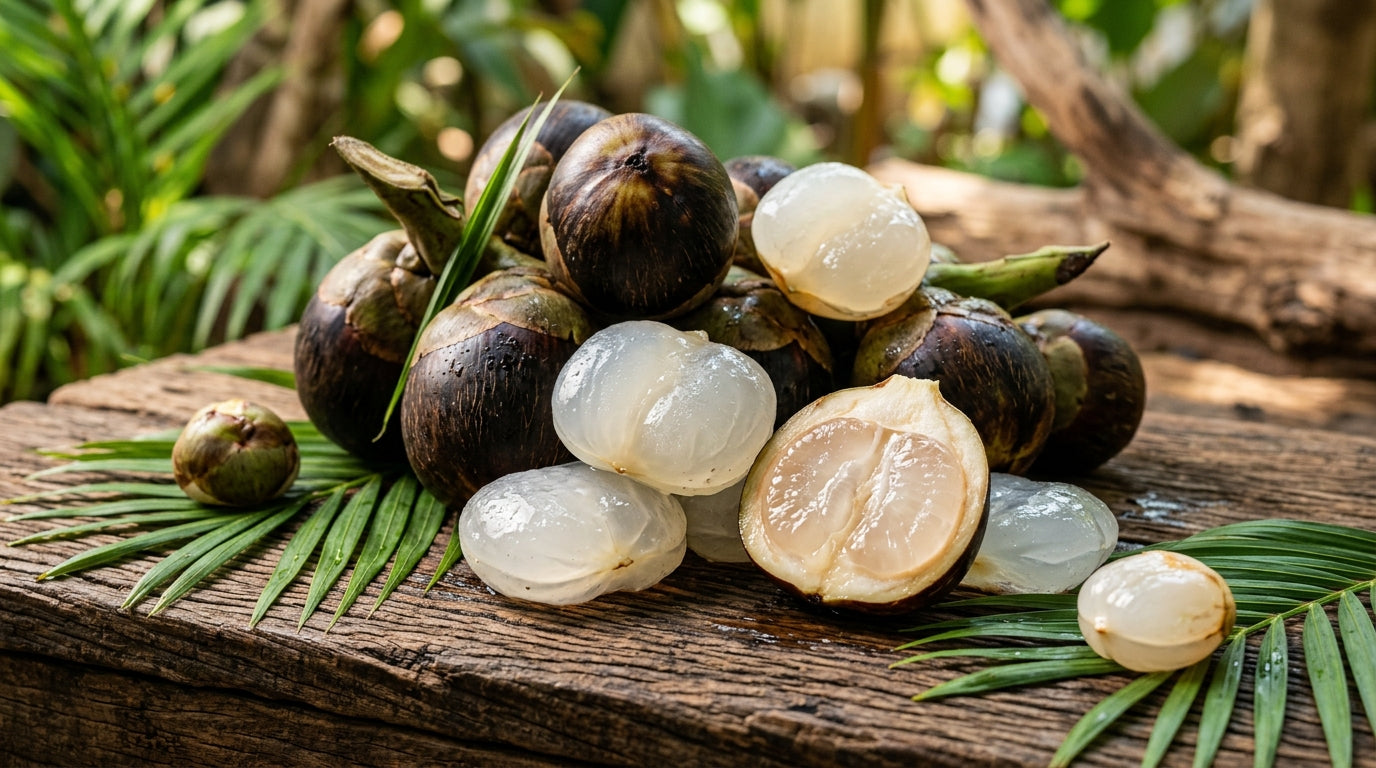
Ice apple (Borassus flabellifer) is a tropical palm fruit rich in phenolic compounds—including quercetin, hyperoside, and procyanidin B2—that activate the Nrf2-Keap1 antioxidant pathway and inhibit COX-1/2 inflammatory enzymes. An in vitro study demonstrated that ice apple water preserved 153.67% viability of human periodontal ligament fibroblasts compared to controls, outperforming several conventional storage media (PMID: 36866144; PMID: 35859413).

Origin
Ice Apple (Borassus flabellifer), a fruit harvested from the Palmyra palm, is native to tropical regions of South and Southeast Asia, particularly India, Sri Lanka, and Thailand. It thrives in arid climates and coastal zones. This hydrating fruit is valued for its cooling and detoxifying properties.
Potential benefits
- Promotes optimal hydration due to its high water content.
- Supports electrolyte balance with natural potassium, magnesium, and calcium.
- Aids digestion and bowel regularity through its fiber and cooling properties.
- Detoxifies the body by supporting liver and kidney cleansing pathways.
- Enhances skin hydration, elasticity, and antioxidant defense via phenolic compounds.
- Strengthens immunity with vitamin C and flavonoids.
How it works
Ice apple's phenolic constituents—quercetin, hyperoside, and procyanidin B2—bind to Keap1, releasing the transcription factor Nrf2, which translocates to the nucleus and upregulates phase II antioxidant enzymes including heme oxygenase-1 (HO-1), NAD(P)H quinone oxidoreductase 1 (NQO1), and glutathione S-transferase (GST). Quercetin and procyanidin B2 simultaneously inhibit cyclooxygenase-1 and cyclooxygenase-2 (COX-1/2) enzymes, suppressing the conversion of arachidonic acid to pro-inflammatory prostaglandins PGE2 and thromboxane A2. The fruit's high potassium content (~250 mg per 100 g pulp) activates Na⁺/K⁺-ATPase pumps, supporting transmembrane electrochemical gradients essential for cellular hydration and electrolyte homeostasis. Additionally, in vitro evidence suggests these bioactives preserve mitochondrial membrane potential in periodontal ligament fibroblasts, indicating broad cytoprotective signaling beyond antioxidant defense alone (PMID: 36866144).
What the research says
Evidence for ice apple is limited to preliminary in vitro studies with no human clinical trials available. One laboratory study tested ice apple fruit pulp extract (IAFPE) as a storage medium for periodontal ligament cells, showing 10% IAFPE preserved 153.67% cell viability at 1 hour compared to controls. At 3 hours, ice apple water maintained 106.67% viable cells with statistical significance (p=0.001). The current evidence base is insufficient to establish clinical efficacy, requiring controlled human trials for therapeutic validation.
Safety and interactions
Ice apple is generally regarded as safe when consumed as a whole food; no serious adverse effects have been reported in traditional dietary use across South and Southeast Asia. Due to its potassium content, individuals taking potassium-sparing diuretics (e.g., spironolactone, amiloride) or ACE inhibitors should exercise caution, as excessive intake could theoretically contribute to hyperkalemia. Quercetin, a key phenolic in ice apple, is a known inhibitor of CYP3A4 and CYP1A2 in vitro, which may alter the metabolism of drugs such as cyclosporine, statins, and certain anticoagulants, though clinically significant interactions from dietary fruit consumption alone have not been established. Pregnant and breastfeeding women should consume ice apple in normal dietary amounts only, as concentrated extracts have not been evaluated for reproductive safety.
Suggested use
- Traditional forms: Eaten fresh, often chilled, or consumed in Ayurvedic practices for cooling and detoxification.
- Modern applications: Incorporated into tropical drinks, desserts, smoothies, juices, and skincare products.
- Recommended dosage: 1–2 whole fruits daily or 1 cup of juice.
Frequently asked questions
What are the top health benefits of ice apple?
Ice apple offers potent hydration (approximately 90% water content), electrolyte replenishment via natural potassium, magnesium, and calcium, antioxidant protection from phenolic compounds like quercetin and procyanidin B2, digestive support through dietary fiber, and skin health enhancement. An in vitro study (PMID: 36866144) also demonstrated its remarkable cytoprotective properties, preserving 153.67% cell viability in human periodontal ligament fibroblasts.
Is ice apple good for hydration in summer?
Yes, ice apple is one of the most effective natural hydrating fruits available in tropical climates. Its pulp contains roughly 90% water along with natural electrolytes—potassium, sodium, magnesium, and calcium—making it functionally similar to an oral rehydration solution and ideal for preventing heat-related dehydration.
What is the nutritional value of ice apple per 100 grams?
Per 100 g of edible pulp, ice apple provides approximately 43 kcal, 90 g water, 1 g protein, 0.1 g fat, 10 g carbohydrates, and notable amounts of potassium (~250 mg), calcium (~27 mg), phosphorus (~30 mg), and vitamin C (~5 mg). It also contains bioactive flavonoids including quercetin, hyperoside, and procyanidin B2 that confer antioxidant and anti-inflammatory activity.
Can ice apple help with skin health and anti-aging?
Ice apple's phenolic compounds activate the Nrf2-Keap1 antioxidant pathway, upregulating protective enzymes like HO-1 that neutralize reactive oxygen species responsible for collagen degradation and premature aging. Its high water content also supports dermal hydration from within, while quercetin has been shown to inhibit matrix metalloproteinases (MMPs) involved in skin elasticity loss.
How does ice apple compare to coconut water for hydration?
Both ice apple and coconut water are excellent natural hydrators with similar electrolyte profiles, but ice apple has a slightly higher water-to-calorie ratio and contains unique phenolic antioxidants—quercetin, hyperoside, and procyanidin B2—not typically present in coconut water. Ice apple also provides more dietary fiber per serving, supporting digestive health alongside hydration. Both are traditionally consumed in tropical regions as cooling beverages during summer.
Is ice apple safe for people with diabetes or blood sugar concerns?
Ice apple is relatively low in sugar compared to many tropical fruits, making it a suitable option for those monitoring blood glucose levels. However, individuals with diabetes should consume it in moderation as part of a balanced diet and monitor their individual response. The natural sugars and fiber content work together to provide gradual energy without rapid blood sugar spikes. Consulting with a healthcare provider about portion sizes is recommended for those with diabetes management concerns.
Can ice apple interact with medications like diuretics or blood pressure drugs?
Ice apple's high potassium and mineral content may have mild interactions with certain medications, particularly diuretics and ACE inhibitors used for blood pressure management. Individuals taking these medications should consult their healthcare provider before significantly increasing ice apple consumption, as the electrolyte content could affect medication efficacy. The fruit is generally safe for most people, but medical supervision is important for those on specific pharmaceutical regimens. Moderation and timing of consumption separate from medication intake can help minimize potential interactions.
What is the best way to consume ice apple for maximum nutrient absorption and hydration benefits?
Fresh ice apple is best consumed whole or as fresh juice to preserve heat-sensitive nutrients and maintain its hydrating properties. Consuming it with meals can enhance mineral absorption, though drinking the juice on an empty stomach provides rapid hydration and electrolyte replenishment. The cooling properties of ice apple are most effective when consumed fresh and at room temperature or chilled, making it ideal for post-exercise or summer hydration. Storing cut ice apple in the refrigerator and consuming within 24 hours ensures optimal nutrient retention and safety.
References
- https://www.ncbi.nlm.nih.gov/search/all/?term=Ice+Apple
- https://fdc.nal.usda.gov/fdc-app.html#/search?query=Ice+Apple
- https://www.ncbi.nlm.nih.gov/pmc/articles/PMC4071686/
- https://doi.org/10.1016/j.foodres.2020.109651
- https://pubmed.ncbi.nlm.nih.gov/26767951/
This article is educational and is not medical advice. Statements have not been evaluated by the FDA and are not intended to diagnose, treat, cure, or prevent any disease. Consult a healthcare professional before use.