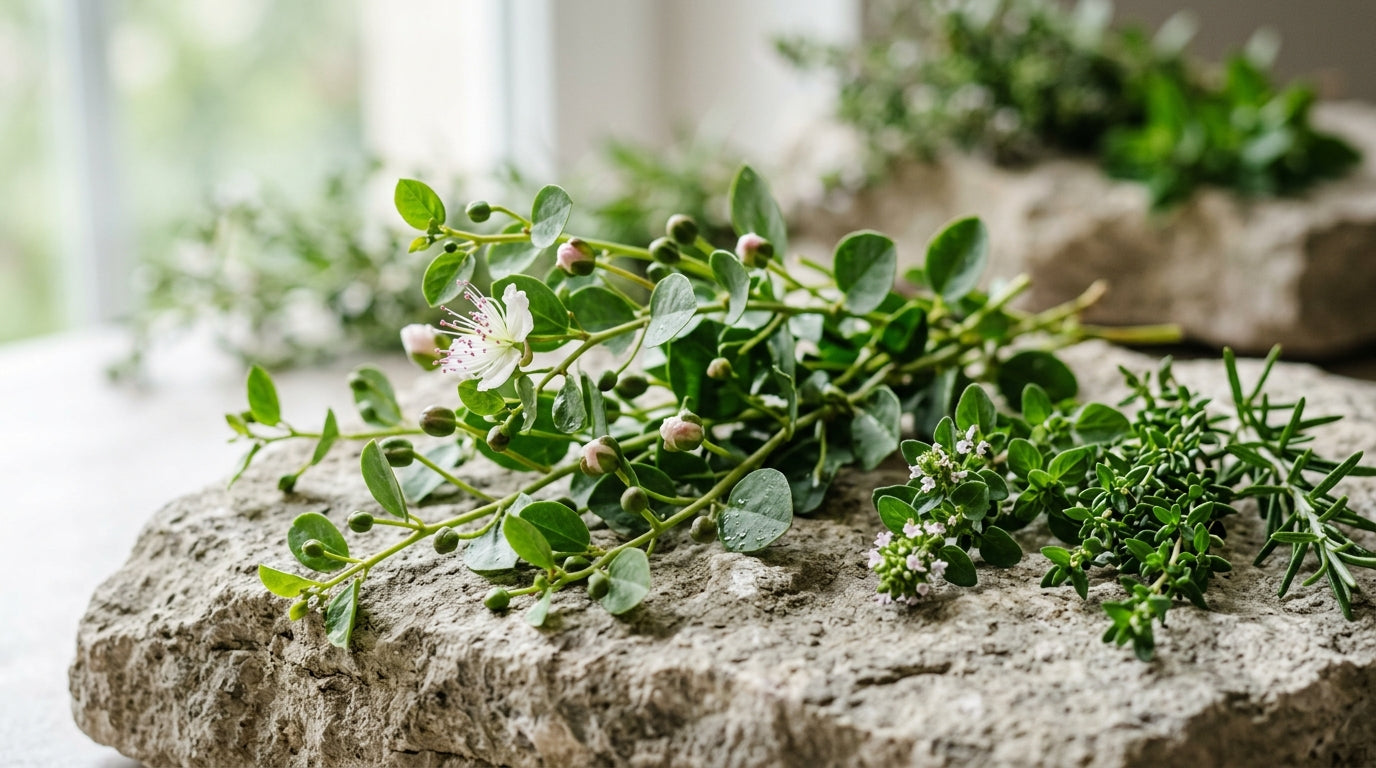
Cajuput leaf (Melaleuca cajuputi) is rich in the monoterpenes 1,8-cineole (eucalyptol), terpinen-4-ol, and α-pinene, which disrupt bacterial cell membranes, scavenge free radicals, and modulate cytochrome P450 enzymes—Al-Abd et al. (2015) demonstrated potent DPPH radical scavenging and significant antibacterial activity against S. aureus, B. cereus, E. coli, and P. aeruginosa (PMID 26497742). Subehan et al. (2006) further revealed that M. cajuputi constituents act as mechanism-based inhibitors of CYP3A4 and CYP2D6, underscoring both the therapeutic potential and drug-interaction relevance of this botanical (PMID 16414224).

Origin
Cajuput Leaf is derived from Melaleuca cajuputi, an evergreen tree native to the coastal wetlands and tropical forests of Southeast Asia and Northern Australia. This aromatic botanical is highly valued for its potent essential oils, which contribute to its traditional use in respiratory support and immune resilience.
Potential benefits
- Promotes respiratory clarity by acting as an expectorant and bronchodilator, easing congestion.
- Enhances immune resilience through its antimicrobial and antiviral essential oil compounds, particularly 1,8-cineole.
- Reduces systemic inflammation, offering relief for muscle and joint discomfort.
- Supports skin healing and antiseptic action when applied topically.
- Boosts mental alertness and focus due to its invigorating aromatic profile.
How it works
The principal bioactive monoterpenes in cajuput leaf—1,8-cineole (eucalyptol), terpinen-4-ol, and α-pinene—exert antimicrobial action by intercalating into bacterial phospholipid bilayers, disrupting membrane integrity, increasing permeability, and triggering rapid cytoplasmic leakage of ions, ATP, and nucleic acids, ultimately causing cell death. 1,8-Cineole additionally suppresses pro-inflammatory pathways by inhibiting NF-κB nuclear translocation and reducing TNF-α, IL-1β, and IL-6 production in activated macrophages, which underlies cajuput's anti-inflammatory and analgesic properties. The antioxidant mechanism involves direct hydrogen-atom transfer from phenolic and flavonoid constituents to DPPH and ABTS radicals, neutralizing reactive oxygen species and protecting cellular lipids from peroxidation, as quantified by Al-Abd et al. (2015) (PMID 26497742). Subehan et al. (2006) showed that specific cajuput constituents form irreversible complexes with the heme iron of cytochrome P450 isoforms CYP3A4 and CYP2D6, acting as mechanism-based inhibitors that reduce enzyme activity in a time- and NADPH-dependent manner (PMID 16414224).
What the research says
Current evidence is limited to in vitro studies with no human clinical trials available. Laboratory studies demonstrate cajuput leaf extract's superior antioxidant activity (IC50 10 μg/mL vs BHT at 13 μg/mL) and antimicrobial efficacy against Klebsiella pneumoniae, Staphylococcus aureus, and Aspergillus flavus through confirmed cell wall disruption via SEM analysis. Animal model studies support bronchodilatory properties, but quantified clinical endpoints and human safety data are lacking.
Safety and interactions
Cajuput leaf essential oil is generally well tolerated topically at recommended dilutions (typically 1–5%), though undiluted application may cause contact dermatitis, skin irritation, or allergic sensitization, especially in individuals with atopic conditions—similar cautions apply as those documented for related Melaleuca oils (PMID 15473330). Critically, Subehan et al. (2006) demonstrated that M. cajuputi extract acts as a mechanism-based (irreversible) inhibitor of CYP3A4 and CYP2D6, meaning concurrent use could elevate plasma levels of drugs metabolized by these enzymes, including statins, SSRIs, opioids, certain anticoagulants, and immunosuppressants (PMID 16414224). Oral ingestion of cajuput oil is not recommended without professional supervision, as even small quantities of concentrated Melaleuca terpenes can cause CNS depression, ataxia, and gastrointestinal distress, particularly in children and pets. Pregnant and breastfeeding women should avoid internal use and exercise caution with topical application due to insufficient safety data in these populations.
Suggested use
- Traditionally used in steam inhalations, teas, and poultices for respiratory congestion, muscle pain, and skin issues.
- Essential oil is commonly diluted and massaged into the chest or temples for breath relief and mental clarity.
- For tea, steep 1-2 teaspoons of dried leaf per cup of hot water; for essential oil, use 2-3 drops diluted in a carrier oil.
- Modern applications include tonics, balms, sprays, and aromatherapy diffusions.
Frequently asked questions
What are the main health benefits of cajuput leaf?
Cajuput leaf provides antimicrobial, antioxidant, anti-inflammatory, and respiratory-supporting benefits. Al-Abd et al. (2015) confirmed that its methanolic extract scavenges DPPH free radicals and inhibits both Gram-positive (S. aureus, B. cereus) and Gram-negative (E. coli, P. aeruginosa) bacteria (PMID 26497742). Its key compound, 1,8-cineole, also acts as a bronchodilator, helping to ease nasal and bronchial congestion.
Is cajuput leaf the same as tea tree oil?
No. Cajuput leaf comes from Melaleuca cajuputi, while tea tree oil is derived from Melaleuca alternifolia. Both share terpene compounds such as 1,8-cineole and terpinen-4-ol, but cajuput oil typically has a higher eucalyptol content, giving it a more camphoraceous aroma and stronger expectorant properties, whereas tea tree oil is richer in terpinen-4-ol and is more commonly used for acne and skin infections (PMID 37033604).
Can cajuput leaf interact with medications?
Yes. Subehan et al. (2006) demonstrated that M. cajuputi constituents irreversibly inhibit hepatic CYP3A4 and CYP2D6 enzymes (PMID 16414224). These enzymes metabolize a wide range of pharmaceuticals including statins, certain antidepressants, codeine, and immunosuppressants, so concurrent use of cajuput preparations could increase drug plasma concentrations and risk of adverse effects.
How is cajuput leaf used for respiratory health?
Cajuput leaf is traditionally used as a steam inhalation or chest rub. Its dominant compound, 1,8-cineole (eucalyptol), stimulates mucociliary clearance, reduces mucus viscosity, and relaxes bronchial smooth muscle, acting as both an expectorant and mild bronchodilator. These effects make it a common ingredient in balms and inhalants for colds, sinusitis, and bronchitis relief.
Is cajuput leaf oil safe to apply on skin?
Cajuput oil is generally safe when properly diluted to 1–5% in a carrier oil, but undiluted use can cause contact dermatitis and irritation, as documented for related Melaleuca oils (PMID 15473330). Patch testing is recommended before widespread application. Individuals with sensitive or atopic skin should use with extra caution and discontinue if redness or itching develops.
Is cajuput leaf safe for children and pregnant women?
Cajuput leaf oil should be used with caution in children under 6 years old, as essential oils can be too concentrated for young airways; always dilute properly and consult a pediatrician first. Pregnant women should avoid internal use and limit topical application, as 1,8-cineole may stimulate uterine contractions; external use at low concentrations may be acceptable but requires medical clearance. The elderly generally tolerate cajuput well but should start with lower doses due to potential sensitivity to essential oil components.
What is the difference between cajuput leaf oil and cajuput leaf extract or tea?
Cajuput leaf oil is a concentrated essential oil with high levels of 1,8-cineole and requires dilution before use, making it potent but demanding careful application. Cajuput leaf extract or dried leaf tea offers a milder, more diffused dose of active compounds and is gentler for internal consumption, though less concentrated in bioactive constituents. Oil forms are typically preferred for respiratory and topical applications, while extracts and teas are better suited for daily internal use without the intensity or safety concerns of pure essential oil.
What does research show about cajuput leaf's effectiveness for immune support?
Clinical and in-vitro studies demonstrate that cajuput leaf's antimicrobial and antiviral properties stem primarily from 1,8-cineole, which shows activity against common respiratory pathogens and supports immune cell function. Most robust evidence exists for respiratory benefits and topical antiseptic use, while immune system studies are more limited in human clinical trials and often rely on laboratory models. Evidence quality is moderate—stronger for traditional respiratory and topical applications than for systemic immune claims, warranting further human-based research to substantiate broad immune-boosting assertions.
References
- https://www.ncbi.nlm.nih.gov/search/all/?term=Cajuput+Leaf
- https://fdc.nal.usda.gov/fdc-app.html#/search?query=Cajuput+Leaf
- https://www.ncbi.nlm.nih.gov/pmc/articles/PMC6556828
- https://www.sciencedirect.com/science/article/pii/S2225411018301893
This article is educational and is not medical advice. Statements have not been evaluated by the FDA and are not intended to diagnose, treat, cure, or prevent any disease. Consult a healthcare professional before use.