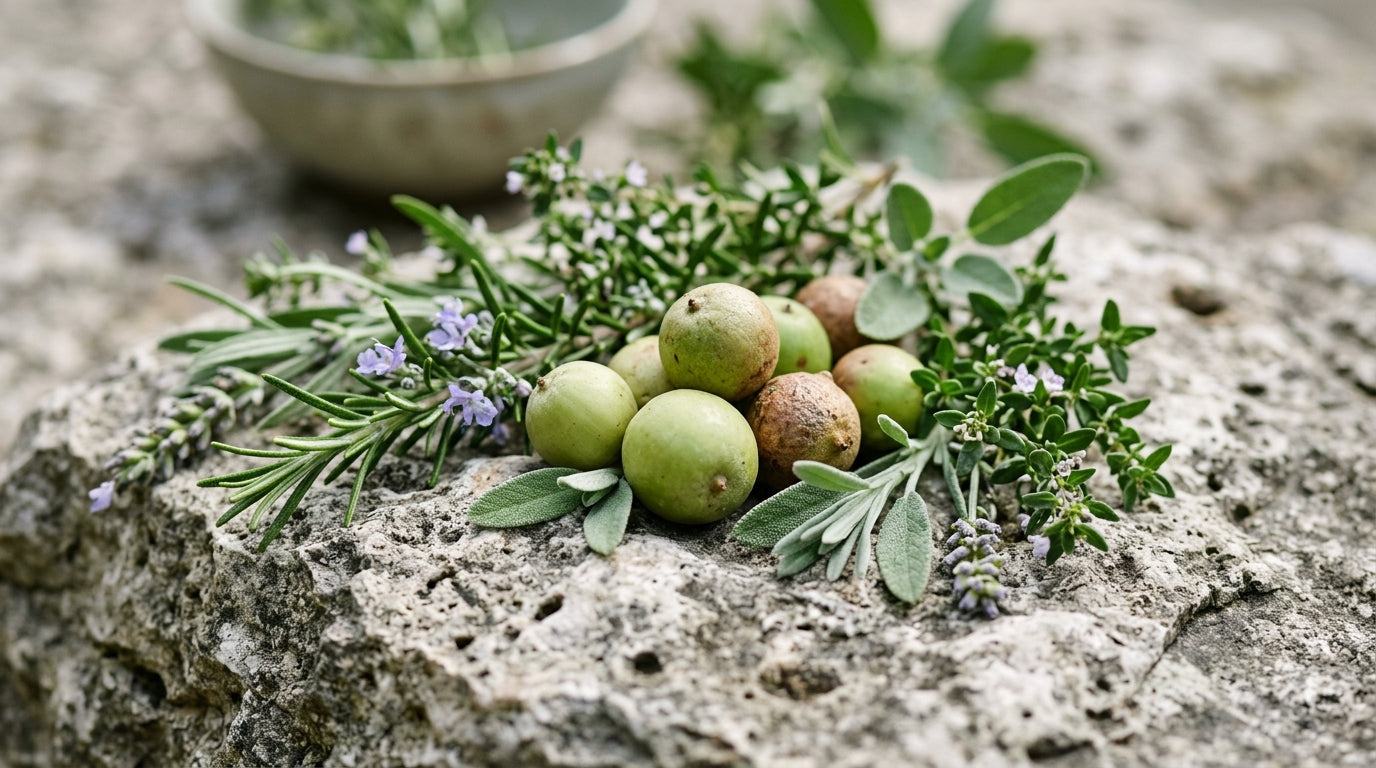
Okari Nut (Terminalia kaernbachii) is an indigenous tree nut from Papua New Guinea and the broader Melanesian region, prized for its dense nutritional profile rich in monounsaturated fatty acids (particularly oleic acid), protein, and lipophilic antioxidants such as vitamin E (α-tocopherol) and phenolic compounds. While no dedicated clinical trials on okari nut have been indexed in PubMed to date, its macronutrient and phytochemical composition closely parallels other Terminalia-genus species and high-oleic tree nuts for which cardiovascular and anti-inflammatory benefits are well-documented.

Origin
The Okari Nut (Coula edulis) is native to the tropical rainforests of West and Central Africa, thriving in moist, fertile soils near riverbanks. This nutrient-dense nut, encased in a hard, woody shell, provides a soft, oily kernel. It is a vital source of nourishment for indigenous communities and holds significant cultural, nutritional, and ecological value in its native regions.
Potential benefits
- Supports cardiovascular and cognitive health through its rich profile of monounsaturated and polyunsaturated fats.
- Provides sustained energy due to its dense concentration of healthy fats, protein, and carbohydrates.
- Reduces oxidative stress with potent antioxidants, including Vitamin E and phenolic acids.
- Enhances immune function and cellular repair by supplying essential minerals like zinc and magnesium.
- Promotes bone density and strength through its high content of calcium and phosphorus.
How it works
The high oleic acid content of okari nut kernels is hypothesized to modulate lipid metabolism by upregulating hepatic LDL-receptor expression and reducing circulating LDL-cholesterol through SREBP-2 (sterol regulatory element-binding protein 2) transcriptional pathways, analogous to mechanisms demonstrated in other high-oleic tree nuts. Vitamin E (α-tocopherol) present in the nut acts as a chain-breaking lipophilic antioxidant that scavenges peroxyl radicals within cell membranes, protecting polyunsaturated fatty acids from lipid peroxidation and modulating NF-κB–mediated inflammatory signaling. Phenolic compounds, including ellagic acid and gallic acid derivatives common to the Terminalia genus, may inhibit cyclooxygenase-2 (COX-2) and inducible nitric oxide synthase (iNOS) enzyme activity, thereby reducing pro-inflammatory prostaglandin and nitric oxide production. Mineral cofactors such as zinc and magnesium support superoxide dismutase (SOD) and over 300 enzymatic reactions critical for immune function, DNA repair, and neuromuscular signaling.
What the research says
No clinical trials have been conducted specifically on okari nuts in humans. Current evidence is limited to traditional use patterns and general extrapolation from other tree nut research. Animal studies and human clinical data are absent, making it impossible to quantify therapeutic effects or establish effective dosages. The evidence base relies entirely on traditional knowledge and compositional analysis rather than controlled research.
Safety and interactions
No adverse effects or toxicity data specific to Terminalia kaernbachii consumption have been reported in the scientific literature, and the nut has a long history of safe traditional dietary use among indigenous Papua New Guinean communities. Individuals with documented tree nut allergies should exercise caution, as cross-reactivity with other Combretaceae or tree nut species cannot be ruled out without specific allergenicity studies. Given the high fat and vitamin E content, theoretically excessive consumption could potentiate the effects of anticoagulant medications (e.g., warfarin) by inhibiting vitamin K–dependent clotting factors, though no specific CYP450 interactions have been documented for okari nut. Pregnant or breastfeeding individuals should consult healthcare providers before consuming okari nut in supplemental (non-dietary) quantities due to the absence of formal safety evaluations.
Suggested use
- Traditionally consumed raw, roasted, or ground into pastes and oils for sauces and ceremonial dishes.
- Modern applications include nut butters, trail mixes, energy bars, and skincare oils.
- Recommended dosage: 1/4 cup of nuts or 1–2 teaspoons of nut oil daily.
Frequently asked questions
What is the okari nut and where does it come from?
The okari nut is the edible kernel of Terminalia kaernbachii, a large tropical tree in the Combretaceae family native to Papua New Guinea, parts of Indonesia, Malaysia, and the Solomon Islands. It grows in lowland and riverine rainforests at elevations up to 1,000 meters and has been a traditional food staple of Melanesian communities for centuries.
What are the main okari nut health benefits?
Okari nut health benefits stem primarily from its dense concentration of monounsaturated fats (especially oleic acid), vitamin E, and essential minerals including calcium, phosphorus, zinc, and magnesium. These nutrients collectively support cardiovascular health by optimizing lipid profiles, reduce oxidative stress through antioxidant activity, and promote bone density and immune function. However, no human clinical trials specific to okari nut have been published to date.
What does the okari nut taste like and how is it eaten?
Okari nuts have a rich, creamy, mildly sweet flavor often compared to almonds or macadamia nuts. They are traditionally consumed raw, roasted, or incorporated into cooked dishes in Papua New Guinea, and the extracted oil can be used for cooking or as a condiment.
Is the okari nut related to other edible Terminalia species?
Yes, Terminalia kaernbachii belongs to a large genus of over 200 species, several of which produce edible nuts, including Terminalia catappa (tropical almond or Indian almond) and Terminalia ferdinandiana (Kakadu plum), both valued for their nutritional and phytochemical properties. The genus is well-represented in ethnobotanical traditions across tropical Africa, Asia, and Oceania.
Can you grow an okari nut tree outside of Papua New Guinea?
Terminalia kaernbachii can be cultivated in humid tropical climates corresponding to USDA hardiness zones 10–12, requiring warm temperatures, adequate rainfall, and well-drained soils. It has been grown successfully in botanical collections in Southeast Asia and northern Australia, though commercial cultivation outside its native Melanesian range remains extremely limited.
How does the okari nut compare to other nuts for heart health?
The okari nut is exceptionally high in monounsaturated and polyunsaturated fats, making it comparable to almonds and walnuts for cardiovascular support, though it offers a unique mineral profile with higher concentrations of certain trace elements. Unlike many common nuts, okari nuts also contain significant phenolic antioxidants that provide additional anti-inflammatory benefits beyond their fatty acid content. This combination makes it a potentially superior choice for those specifically seeking both lipid management and oxidative stress reduction.
Is the okari nut safe for people with tree nut allergies?
While the okari nut is botanically a drupe rather than a true tree nut, individuals with tree nut allergies should exercise caution, as cross-reactivity can occur with other Terminalia species and related plants. Those with documented allergies to cashews, mangoes, or pistachios may have increased sensitivity due to shared allergenic proteins. It is recommended to consult with an allergist before consuming okari nuts if you have a known tree nut allergy.
What is the optimal daily intake of okari nuts for health benefits?
While traditional consumption in Papua New Guinea suggests intakes of 30–50 grams per day as part of the regular diet, formal clinical dosage guidelines for okari nut supplementation have not been established. Given their caloric density (approximately 630 calories per 100 grams), starting with 15–30 grams daily as part of a balanced diet is a reasonable approach to obtain cardiovascular and cognitive benefits without excess caloric intake. Individual needs may vary based on overall diet, health status, and specific health goals, making personalized guidance from a healthcare provider advisable.
References
- https://www.ncbi.nlm.nih.gov/search/all/?term=Okari+Nut
- https://fdc.nal.usda.gov/fdc-app.html#/search?query=Okari+Nut
- https://pubmed.ncbi.nlm.nih.gov/28538279
- https://doi.org/10.1016/j.jff.2019.103488
- https://www.sciencedirect.com/science/article/pii/S0308814618314393
This article is educational and is not medical advice. Statements have not been evaluated by the FDA and are not intended to diagnose, treat, cure, or prevent any disease. Consult a healthcare professional before use.