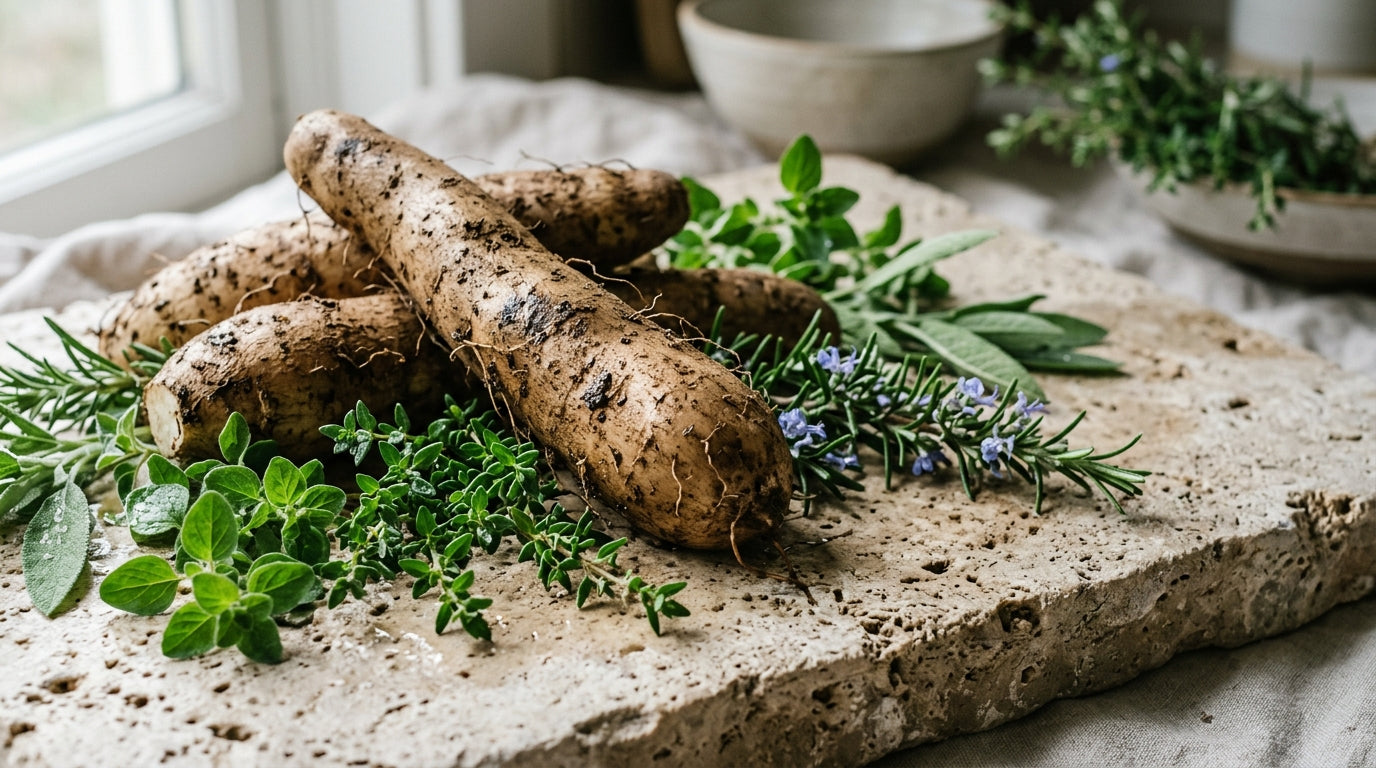
Dragon Tree Bark resin contains high concentrations of phenolic compounds and flavonoids, with methanolic extracts yielding up to 110 ± 0.83 mg QE/g total flavonoids. These bioactive compounds demonstrate significant enzyme inhibition, including 73.46% tyrosinase inhibition and up to 64.06% acetylcholinesterase inhibition in laboratory studies.

Origin
Dragon Tree Bark, often associated with the "Dragon's Blood" resin, comes from various species including Dracaena draco (Canary Islands, North Africa), Dracaena cinnabari (Socotra), and Croton lechleri (Amazon). These trees thrive in volcanic highlands, dry forests, and rocky slopes across their respective native regions. The bark and resin are highly valued for their traditional healing and protective properties.
Potential benefits
- Promotes wound healing and skin regeneration through its astringent and cytoprotective compounds.
- Modulates inflammation and oxidative stress via its rich polyphenol content.
- Offers antiviral and antimicrobial defense against various pathogens.
- Supports gut lining integrity and aids internal cleansing.
- Enhances immune resilience and strengthens overall defense mechanisms.
- Contributes to cognitive clarity by reducing oxidative damage.
- Supports cardiovascular health by improving circulation.
How it works
Dragon Tree Bark resin exerts its effects through phenolic compounds and flavonoids that inhibit key enzymes including tyrosinase (73.46% inhibition), acetylcholinesterase (up to 64.06% inhibition), and butyrylcholinesterase (up to 50.97% inhibition). The resin's anti-inflammatory activity occurs through inhibition of nitrite, TNF-α, and IL-6 in immune cells, while anticancer effects involve upregulation of pro-apoptotic proteins Bax and Caspase-3 alongside downregulation of p53, Bcl-2, and Cox-2. Antidiabetic properties result from α-glucosidase and α-amylase inhibition via hydrogen bonding to catalytic residues ASP404 and ARG600.
What the research says
Current evidence for Dragon Tree Bark resin is limited to in vitro and animal studies, with no human clinical trials reported. Laboratory studies demonstrate that Dracaena cinnabari extracts achieve 50% inhibition of MCF-7 breast cancer cells at 100 μg/mL concentration, while 1000 mg/kg extract dosing in animal models showed inhibition of proliferation markers cyclin D1, Ki-67, and Bcl-2. Extensive research on related Croton lechleri resin shows promising wound healing and antiviral properties in animal models. The lack of human clinical data significantly limits the ability to confirm therapeutic efficacy and appropriate dosing protocols for clinical applications.
Safety and interactions
No specific safety concerns, drug interactions, or contraindications have been documented for Dragon Tree Bark resin in available literature. Laboratory studies of Dracaena cinnabari extracts showed low cytotoxicity in normal cell lines during anticancer research, suggesting potential selectivity for diseased cells. However, the absence of comprehensive human safety data, including effects during pregnancy and lactation, represents a significant knowledge gap. Given the lack of clinical safety profiles and potential for unknown interactions with medications, consultation with healthcare providers is essential before use, particularly for individuals with existing medical conditions or those taking prescription medications.
Suggested use
- Traditionally, the resin (Dragon's Blood) was used across Indigenous African, Amazonian, and Arabian cultures, applied to wounds, burned as incense, or ingested in minute amounts for ulcers and infections.
- Modern uses for bark/resin include wound salves, gut-repair capsules, antiviral blends, and ceremonial incense.
- Recommended internal dosage (for Croton spp. resin): 100–300 mg/day; external use as directed in balms or salves is preferred.
- For bark extracts, dosages of 500–1000 mg daily are sometimes used in longevity or immune support formulations.
Frequently asked questions
What are the main bioactive compounds in Dragon Tree Bark resin?
Dragon Tree Bark resin contains high concentrations of phenolic compounds and flavonoids, with total phenolic content reaching 92.72 ± 0.79 mg GAE/g in n-butanol fractions. Specific compounds include 4'-hydroxy-7,8-methylenedioxyhomoisoflavan and various other polyphenolic structures that contribute to its therapeutic properties.
How effective is Dragon Tree Bark resin for wound healing?
Laboratory studies show Dragon Tree Bark resin promotes wound healing through astringent and cytoprotective compounds, though human clinical trials are lacking. Related research on Croton lechleri resin demonstrates significant wound healing properties in animal models, but more human studies are needed to confirm clinical efficacy.
Can Dragon Tree Bark resin help with inflammation?
In vitro studies demonstrate that Dragon Tree Bark resin inhibits inflammatory markers including nitrite, TNF-α, and IL-6 in immune cells. The anti-inflammatory effects are attributed to its rich polyphenol content, though human clinical data is not yet available to confirm therapeutic applications.
Is Dragon Tree Bark resin safe to use?
Current safety data is limited to laboratory studies showing low cytotoxicity in normal cells during cancer research. No specific safety concerns or drug interactions have been documented, but the absence of human clinical safety data means potential risks and contraindications remain unknown.
What's the difference between Dragon Tree species used for resin?
Different Dracaena species produce varying concentrations of bioactive compounds, with D. reflexa showing flavonoid content up to 110 ± 0.83 mg QE/g in methanolic extracts. Species like D. cinnabari, D. draco, and D. angustifolia each contain unique compound profiles that may influence their therapeutic potential and traditional uses.
What is the typical dosage range for Dragon Tree Bark supplements?
Dragon Tree Bark dosage typically ranges from 500–2,000 mg daily, depending on the form (extract, powder, or resin) and intended use. For wound healing applications, 1,000–1,500 mg daily is common, while lower doses (500–750 mg) are often used for general immune support. It is advisable to start with a lower dose and gradually increase while monitoring tolerance, and to follow product-specific instructions or consult a healthcare provider for personalized recommendations.
Does Dragon Tree Bark interact with common medications or blood thinners?
Dragon Tree Bark contains polyphenols and tannins that may have mild anticoagulant properties, so concurrent use with blood-thinning medications (such as warfarin or aspirin) should be discussed with a healthcare provider. The astringent compounds in Dragon Tree Bark may also potentially affect the absorption of certain oral medications by altering gastrointestinal pH and transit time. Those taking medications for inflammation, immune function, or gastrointestinal health should consult their practitioner before supplementing with Dragon Tree Bark to rule out additive or antagonistic effects.
Who benefits most from Dragon Tree Bark supplementation, and who should avoid it?
Dragon Tree Bark is most beneficial for individuals with compromised gut integrity, chronic inflammation, recurrent infections, or slow-healing wounds, as its cytoprotective and antimicrobial properties directly support these concerns. Pregnant and nursing women should avoid Dragon Tree Bark due to insufficient safety data and its potent bioactive compounds. Those with severe liver disease, active bleeding disorders, or severe tannin sensitivity should also avoid this ingredient, as should individuals taking multiple polyphenol-rich supplements to prevent excessive intake.
References
- https://fdc.nal.usda.gov/fdc-app.html#/search?query=Dragon+Tree+Bark
- https://fdc.nal.usda.gov/fdc-app.html#/search?query=Dragon+Tree+Fruit
- https://www.ncbi.nlm.nih.gov/search/all/?term=Dragon+Tree+Bark
- https://www.ncbi.nlm.nih.gov/search/all/?term=Dragon+Tree+Fruit
- https://www.ncbi.nlm.nih.gov/search/all/?term=Dragon+Tree+Resin
- https://pubmed.ncbi.nlm.nih.gov/34975643/
- https://www.ncbi.nlm.nih.gov/pmc/articles/PMC7102786
- https://www.ncbi.nlm.nih.gov/pmc/articles/PMC7316771/
- https://www.ncbi.nlm.nih.gov/pmc/articles/PMC7386123/
- https://www.sciencedirect.com/science/article/pii/S0378874117304561
- https://www.sciencedirect.com/science/article/pii/S175646462100361X
- https://www.sciencedirect.com/science/article/pii/S2225411015001014
This article is educational and is not medical advice. Statements have not been evaluated by the FDA and are not intended to diagnose, treat, cure, or prevent any disease. Consult a healthcare professional before use.